
Manage restaurant orders in one place
| Date Aug 2022 | Company Re:tech |
| Role Product Design Lead Made product design decisions and execute design from beginning to launch | Mission Transforming an idea discovered during field research into a practical product feature |
Overview
This project showcases how a simple observation can evolve into a robust product idea through the collaborative efforts of team members. With limited resources, we conducted a sequence of activities, including contextual inquiry, user journey mapping, and usability testing with paper prototypes, to make design and product decisions before moving forward with development.
Background
Upon joining the company, I volunteered to work as a cashier at one of our client’s cafes in Vancouver, with the aim of gaining more insight into how restaurant owners run their business. While working there, I discovered that the delivery orders from various platforms were received through different tablets, which took up valuable counter space in an already cramped area.

The idea of integrating the various delivery orders into a single platform started to take shape in my mind.
Contextual Inquiry (active) and User Journey Mapping
To gain a deeper understanding of the use cases in different restaurants, I conducted contextual inquiry studies in three establishments. Based on these studies, I created user journey maps to visualize how orders are processed and identified pain points and potential solutions.
Location 1: Mira Caffe


Location 2: Fish’s Wild (USA, Cupertino)
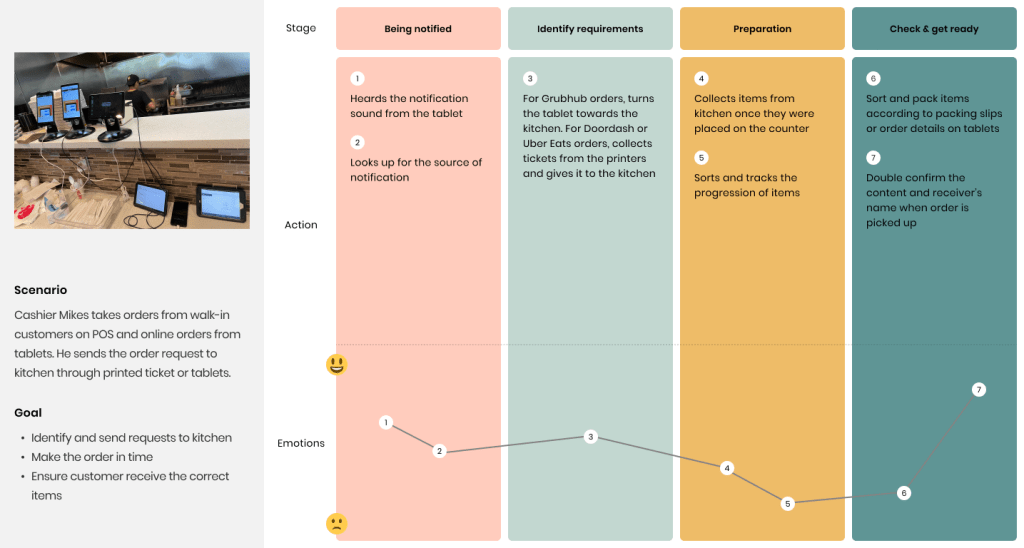
Location 3: Yamato Sushi

After comparing the emotion lines across three locations, we were able to identify two clear requirements based on the findings from our three maps:
- Implement an auto-accept system for orders to minimize the actions required by cashiers.
- Standardize the processing of all orders, regardless of the platform on which they are received.
Present the findings and work with business
During my interviews with restaurant owners in both the United States and Canada who had not yet adopted an integration solution, the primary reason they cited was the cost. For instance, in Canada, the monthly subscription fee for Chowly integration starts at around CA$100, and each additional platform integration costs another CA$20. Given that restaurants typically use 2-3 platforms simultaneously, the total cost could amount to CA$120-CA$140 per month.
I shared my findings with the team and after discussing the potential opportunities, our Director of Business Partnerships took the lead in contacting service providers to negotiate prices. After several months of negotiations, he successfully secured a partnership, which enabled us to offer platform integration to all of our clients for a flat fee of $50. As a result, our stakeholders were encouraged to prioritize the feature in the product.
First design iteration & feedbacks from experts
We began working on the design and initially thought it would be best to consolidate all orders, including those made in-store and online, on the same location. We started from the content audit to understand the need of different types of orders.

and we started the first design draft base on the audit above.

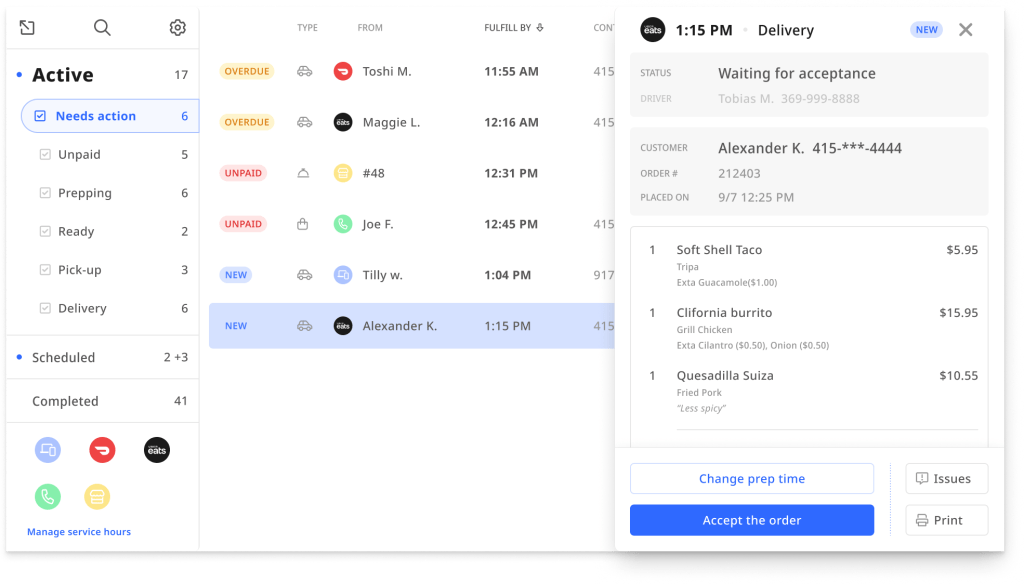
To ensure the design was heading in the right direction, I organized feedback sessions with our Sales Director and Head of Design at our parent company in China, both of whom provided valuable insights based on their experience and industry knowledge.
Key feedbacks from experts:
Different types of orders (in-store, phone, online and third party) in one place is easier for user.
- While delivery orders can be directly sent to the kitchen, in-store and phone orders still require the cashier to manually take orders and payments. Having all types of orders in one place would actually be redundant for users.
Cashier only check orders on the POS station.- In some busier restaurant which has many delivery orders, they would assign a dedicated person to take care all the online orders through a tablet.
Refine the design
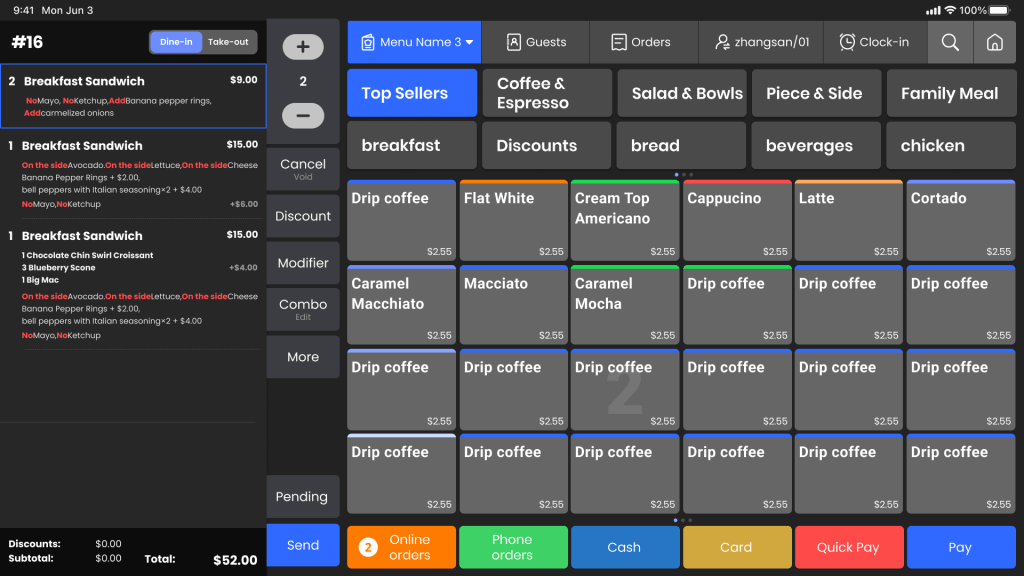
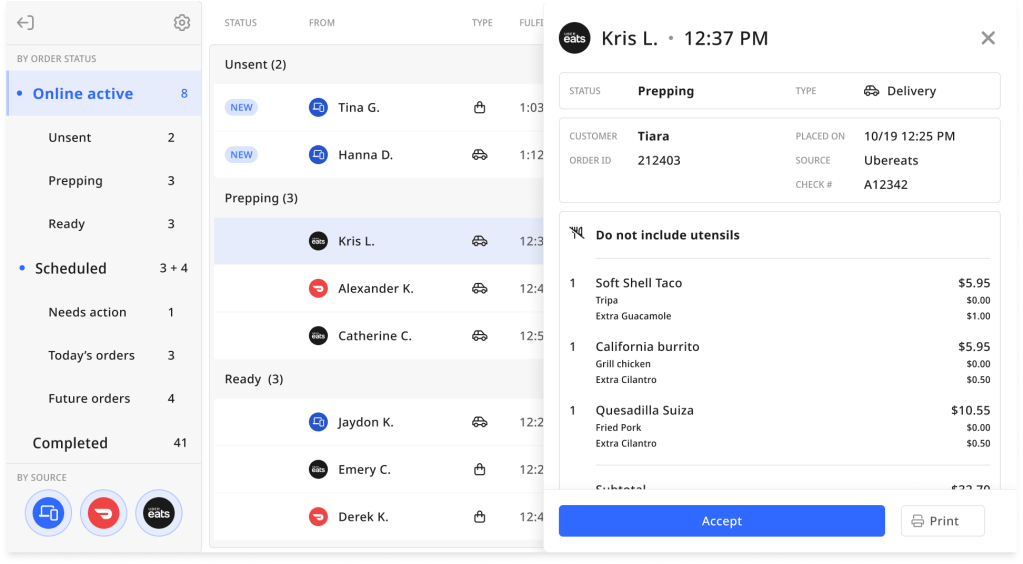
After receiving feedback, we initiated a second round of design and ultimately decided to keep in-store orders (both walk-in and phone orders) on the native Android app for the POS, while all online orders would be accessible via an HTML page that could be loaded directly through a tablet browser.
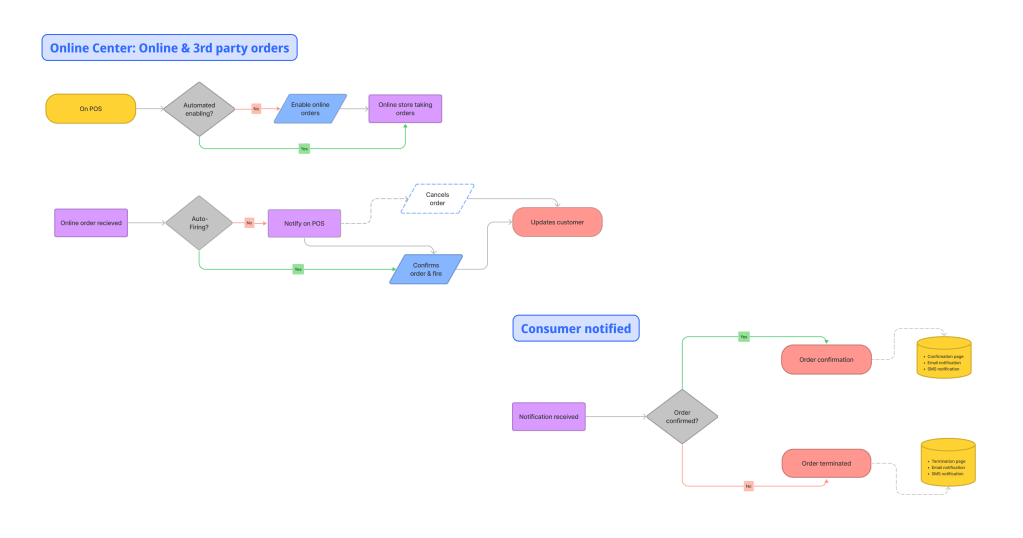
The design includes a progress section that clearly displays all active orders, making it easy for cashiers to take the appropriate action based on the current step of the order.

Beta Launch
The project was launched on Jan 2023 with the first beta customer.
 Shilya Lee